Packaging costs often increase because businesses use oversized boxes, over-specified materials, complicated structures or unnecessary decorative features.
Reducing those costs does not mean lowering packaging quality.
For UK businesses, the better approach is to remove waste while protecting what matters: product safety, structural strength, material performance and professional presentation.
Quick Answer: Businesses can reduce packaging costs by right-sizing boxes, choosing suitable materials, simplifying structures, reducing unnecessary components and using premium finishes more selectively.
Smart Savings: How Brands Cut Packaging Costs, Not Quality
Cheap packaging and cost-efficient packaging are not the same.
A cheaper box may require more tape, protective filling or secondary packaging. If it performs poorly, product damage and replacement costs can quickly cancel out the initial saving.
Smart savings come from improving the packaging specification.
Businesses should review:
- box dimensions
- material choice
- structural design
- print coverage
- inserts
- finishes
- assembly
- storage
- shipping efficiency.
The objective is simple: keep the features that protect the product and support the brand, while removing those that add cost without enough value.
Breaking Down Packaging Cost Reduction in Practical Terms
Packaging cost reduction is about eliminating unnecessary complexity.
It does not mean choosing the thinnest board or removing every premium detail.
A practical review should ask:
- Is the box larger than necessary?
- Is the board heavier than required?
- Does every surface need printing?
- Are all inserts essential?
- Are multiple finishes adding real value?
- Could the structure be easier to assemble?
These decisions often create better savings than simply lowering material quality.
Why Packaging Costs Have a Direct Impact on UK Businesses
Packaging affects more than the box price.
It can influence warehouse space, packing speed, shipping volume, product protection and customer experience.
An inefficient box may:
- use excess material
- need more void fill
- occupy additional storage space;
- take longer to assemble
- increase shipping volume
- allow unnecessary product movement.
When these issues repeat across regular orders, small inefficiencies become larger business costs.
Better packaging design helps reduce those problems without making the packaging look cheaper.
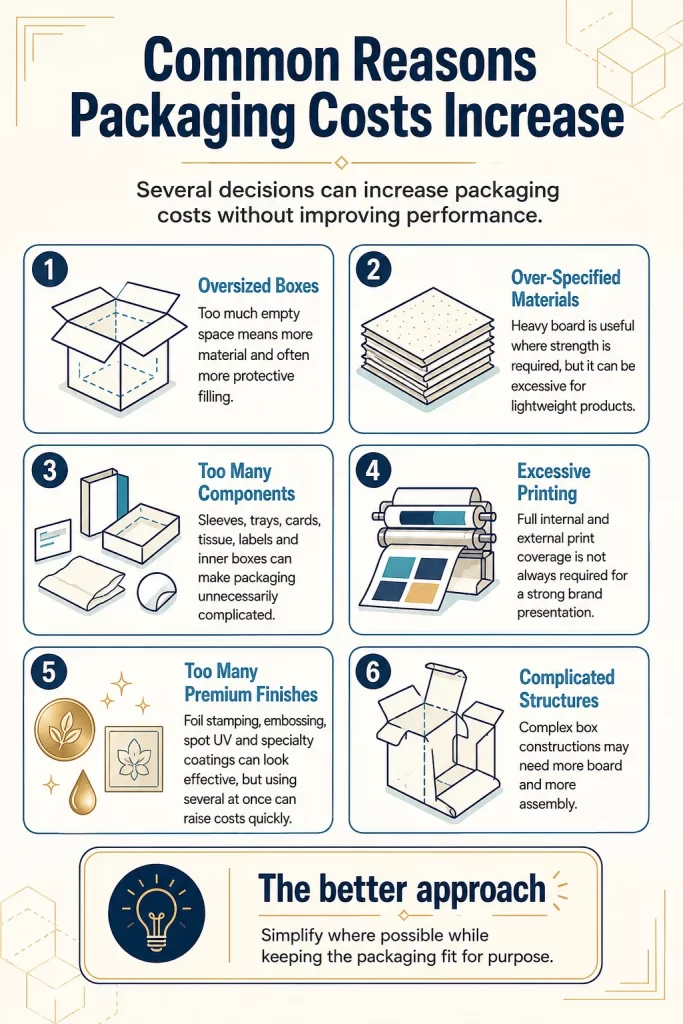
Common Reasons Packaging Costs Increase
Several decisions can increase packaging costs without improving performance.
Oversized Boxes
Too much empty space means more material and often more protective filling.
Over-Specified Materials
Heavy board is useful where strength is required, but it can be excessive for lightweight products.
Too Many Components
Sleeves, trays, cards, tissue, labels and inner boxes can make packaging unnecessarily complicated.
Excessive Printing
Full internal and external print coverage is not always required for a strong brand presentation.
Too Many Premium Finishes
Foil stamping, embossing, spot UV and specialty coatings can look effective, but using several at once can raise costs quickly.
Complicated Structures
Complex box constructions may need more board and more assembly.
The better approach is to simplify where possible while keeping the packaging fit for purpose.
Looking to Reduce Packaging Costs Without Compromising Quality?
Start with the product.
A suitable packaging specification should reflect:
- product dimensions
- weight
- fragility
- sales channel
- storage conditions
- shipping method
- protection requirements
- desired presentation
A lightweight retail item may only need a folding carton, while a fragile ecommerce product may require corrugated protection.
Premium goods may justify rigid packaging, but that does not mean every panel needs foil, lamination or decorative inserts.
Matching the packaging to the product prevents both under-packaging and unnecessary over-engineering.
Popular Products Used by UK Businesses
Different box styles offer different balances between protection, presentation and cost.
Custom Rigid Packaging
Rigid boxes are commonly used for jewellery, cosmetics, gifts and premium retail products.
Because the structure already creates a high-end appearance, businesses can often control costs through simpler finishing.
Useful options include:
- clean paper wraps;
- selective foil details;
- restrained graphics;
- efficient inserts; and
- strong typography.
A premium box does not need to be overloaded with effects.
Custom Kraft Boxes
Kraft packaging works well for brands that prefer a natural, simple appearance.
Its surface supports minimal print designs, which can reduce the need for heavy coatings or complicated artwork.
Kraft boxes are often suitable for soaps, candles, apparel, handmade products and ecommerce goods.
A simple one- or two-colour print can create strong branding without excessive decoration.
Custom Eco-Friendly Boxes
Eco-friendly packaging can also support cost efficiency when it reduces unnecessary material.
Businesses may be able to:
- reduce packaging layers
- remove excess plastic
- use more efficient dimensions
- simplify mixed-material structures
- choose paper-based components where suitable.
However, sustainability should never weaken product protection.
Proven Ways Businesses Reduce Packaging Costs Without Cutting Quality
Right-Sizing Packaging Boxes
Right-sizing is one of the most effective improvements.
A well-sized box leaves enough room for the product and required protection without creating excessive empty space.
This can reduce:
- material use
- void fill
- storage requirements
- shipping volume
- unnecessary movement inside the box.
The goal is not the smallest possible carton. The aim is the most efficient size that still protects the product properly.
Choosing the Right Packaging Materials
Material should be selected according to performance requirements.
Common options include:
- folding carton board for lightweight retail products
- kraft board for simple branded packaging
- corrugated board for ecommerce and shipping
- stronger corrugated grades for heavier or fragile goods
- rigid board for premium presentation.
The best material is the one that provides enough strength without unnecessary over-specification.
Simplifying Packaging Design
Good packaging does not need to be complicated.
Businesses can often reduce production costs by:
- limiting print coverage
- using fewer colours
- choosing one premium finish instead of several
- removing unnecessary sleeves
- simplifying inserts
- reducing decorative components; and
- printing information directly onto the box.
Minimal packaging can still look premium when the structure, typography and print quality are handled well.
Using Custom Boxes Instead of Oversized Stock Packaging
Stock boxes are convenient, but they are not always efficient.
If the carton is much larger than the product, additional filling, tape and protective material may be required.
Custom boxes can be designed around the product’s dimensions, giving businesses better control over fit and presentation.
The main benefit is greater packaging efficiency, not simply custom branding.
Switching to More Efficient Eco-Friendly Packaging
Sustainable packaging improvements can sometimes reduce unnecessary material.
Businesses can review whether they need:
- plastic trays
- heavy lamination
- oversized cartons
- multi-layer inserts
- disposable decorative components.
A simpler structure may reduce material use while also making the packaging easier for customers to recycle.
How Packaging Design Impacts Overall Costs
Packaging design directly affects material usage and production complexity.
Costs can be influenced by:
- box dimensions
- dieline efficiency
- structural complexity
- number of components
- insert construction
- print coverage
- coatings
- finishing methods
- assembly requirements.
A simple structure made from the correct material can often perform better financially than an elaborate design with unnecessary features.
That is why cost control should begin during packaging development, not after the final artwork is complete.
Packaging Options and Cost Considerations
| Packaging Type | General Cost Level | Best Suited For | Main Cost Factor |
| Folding Cartons | Lower to moderate | Lightweight retail goods | Board and printing |
| Kraft Boxes | Lower to moderate | Natural-looking brands | Material and print coverage |
| Corrugated Boxes | Moderate | Ecommerce and shipping | Strength and dimensions |
| Mailer Boxes | Moderate | Direct-to-consumer products | Structure and board use |
| Rigid Boxes | Higher | Premium products | Construction and finishes |
| Custom Inserts | Additional | Fragile or premium products | Material and complexity |
The cheapest structure is not always the most cost-effective option.
Packaging should be judged on how well it protects, presents and supports the product.
Practical Packaging Tips for Cost-Conscious Buyers
Before approving a packaging design, ask:
- Can the box be smaller without affecting protection?
- Is every packaging component necessary?
- Are premium finishes being used strategically?
- Is the material stronger than required?
- Could the structure be easier to assemble?
- Is poor sizing creating unnecessary void fill?
- Could printing replace separate labels or cards?
- Has the packaging been tested with the actual product?
These questions help separate genuine efficiencies from simple cost cutting.
Thinking About Costs? Get Practical Advice Before Ordering
Good packaging decisions start with clear product requirements.
Before finalising a specification, provide your packaging supplier with details such as:
- product dimensions
- weight
- preferred box style
- material requirements
- print expectations
- finishing preferences
- protection needs
- shipping conditions.
This makes it easier to compare practical alternatives before production.
Sometimes a small change to the dieline, material or finish can reduce costs without affecting the finished appearance.
Why Businesses Choose Hi Custom Boxes
We helps UK businesses develop custom packaging around product protection, presentation and practical performance.
Businesses can compare box styles, materials, printing methods and finishing options rather than relying on one generic solution.
The focus should remain on achieving the right balance between cost, protection and visual quality.
Whether the requirement is kraft, corrugated, folding carton or rigid packaging, unnecessary complexity can often be removed without lowering the standard of the finished box.
Final Summary and Next Step
Businesses do not need to sacrifice packaging quality to control costs.
The strongest opportunities usually come from:
- better box sizing
- appropriate material selection
- simpler structures
- reduced excess packaging
- controlled print coverage
- selective finishes
- efficient inserts
- better overall packaging design.
The goal is not simply to make packaging cheaper.
It is to make it more efficient without reducing protection or brand value.
Ready to Reduce Packaging Costs Without Cutting Quality?
If your packaging feels oversized, complicated or more expensive than necessary, review the specification before lowering the material standard.
Adjusting the dimensions, structure, material, printing or finishing may create better savings while keeping the packaging strong and professional.
Speak with Hi Custom Boxes to explore packaging solutions designed around your product, protection requirements and budget.
Need packaging advice for your next order?
Share your box size, material, quantity, and artwork needs. Our team can guide you before production starts.