About This Guide
This post helps UK ice cream brands, parlours and food businesses choose packaging that fits their products and sales channels. Readers will learn how to compare structures, materials, printing options and protective features, avoid common specification mistakes and create packaging that is practical, recognisable and suitable for real-world handling. Ice cream packaging needs to work before it starts to impress. The right box or sleeve should fit the product properly, cope with normal handling, give the brand enough room to communicate clearly and suit the way the product is sold.
For UK ice cream brands, dessert shops and independent food businesses, useful paper-based options include folding cartons, cone sleeves, multipack boxes, dividers and corrugated outer packaging. The best choice depends on the product format and how much protection or branding space is actually needed.
10 Ice Cream Packaging Ideas for UK Brands
1. Custom Printed Ice Cream Boxes
Printed cartons give brands room for logos, flavour names, illustrations and product information.
A consistent structure can also help tie a product range together. Instead of redesigning the box for every flavour, brands can keep the same format and change colour, artwork or typography.
For products that need a complete printed carton, Hi Custom Boxes offers custom printed ice cream boxes with custom dimensions, board choices and different printing options.
2. Branded Ice Cream Cone Sleeves
Cone sleeves are one of the simplest ways to put branding directly into the customer’s hand.
They can carry a logo, flavour cue, colour scheme or short promotional message while keeping part of the cone covered during serving.
For parlours, kiosks, events and dessert businesses, branded ice cream cone sleeves can provide a focused branding surface without requiring a full carton.
3. Multipack Ice Cream Cartons
Multipack cartons are useful when several individually packed frozen products need to be grouped together.
The internal layout matters as much as the exterior. Too much empty space can let products move, while an oversized divider system can make the pack unnecessarily bulky.
A compact carton with simple dividers is often more practical than adding several layers of packaging.
4. Ice Cream Sandwich Boxes
Ice cream sandwiches and similar products may benefit from compact secondary cartons when additional branding or grouping is required.
The carton should remain close to the finished product dimensions. Making the box larger simply to create more print space usually results in a poorer fit.
5. Kraft-Style Ice Cream Packaging
Kraft board can work well for artisan or understated brand positioning.
Simple printing tends to suit the material best. One or two strong colours, clear typography and restrained graphics can make the board itself part of the presentation.
Material selection should still be based on the actual packaging application rather than appearance alone.
6. Minimalist Ice Cream Packaging
Minimalism can help a brand stand out in a category where packaging is often bright and visually busy.
A clean design might use one dominant brand colour, clear flavour naming, limited graphics and plenty of space around the logo.
Minimal packaging should still be distinctive. Removing unnecessary decoration is different from removing personality.
7. Colour-Coded Flavour Packaging
Colour coding is a practical way to organise a larger product range.
Different flavours can use different accent colours while the logo, typography and main box structure remain consistent.
This makes products easier to distinguish without weakening overall brand recognition.
8. Seasonal Ice Cream Packaging
Seasonal ranges do not always need a completely new box.
Summer promotions, festive editions or event products can often use the existing structure with updated artwork, sleeves or selected printed details.
This keeps the product recognisable while giving limited editions a distinct look.
9. Premium Printed Ice Cream Boxes
Premium packaging does not need every available finishing technique.
Foil, embossing or debossing can work well when applied selectively to a logo or small graphic element.
A strong board, accurate print and considered layout usually contribute more to perceived quality than adding several finishes at once.
10. Corrugated Outer Packaging for Delivery
Retail packaging and delivery packaging perform different jobs.
A folding carton may present the product well, while corrugated packaging provides stronger secondary protection during transport.
Where products need to stay separated or controlled inside the outer box, corrugated boxes with inserts can provide a more structured alternative to loose internal filling.
Packaging supports physical protection, but it does not replace suitable temperature-controlled handling for frozen products.
Choose Packaging Around the Ice Cream Product
Different product formats require different structures.
Ice Cream Cones
Cone sleeves provide a practical branding surface for individual servings. Secondary cartons may be needed where cones or related products are grouped together.
Ice Cream Sandwiches
Compact folding cartons can provide additional presentation and help keep a product range visually consistent.
Ice Cream Bars and Lollies
Individually wrapped bars can be grouped inside printed secondary cartons or multipack boxes.
Multipacks
A multipack should keep products organised without creating unnecessary empty space. Dividers are useful when they stop movement or keep individual products separated.
Dessert and Gift Sets
Gift or promotional sets may need compartments or inserts, particularly where several items share one presentation box.
Which Materials Work for Ice Cream Boxes?
The material should suit the structure and handling requirements.
Folding carton board provides a smooth printable surface and works well for many lightweight secondary cartons.
Kraft board suits natural-looking or minimalist branding.
Corrugated board offers more structural strength and is better suited to outer packaging, transport boxes and larger grouped packs.
Rigid board may be appropriate for premium secondary presentation or gift packaging where the structure adds genuine value.
The right choice is not automatically the thickest board. It is the board that provides enough performance for the intended use.
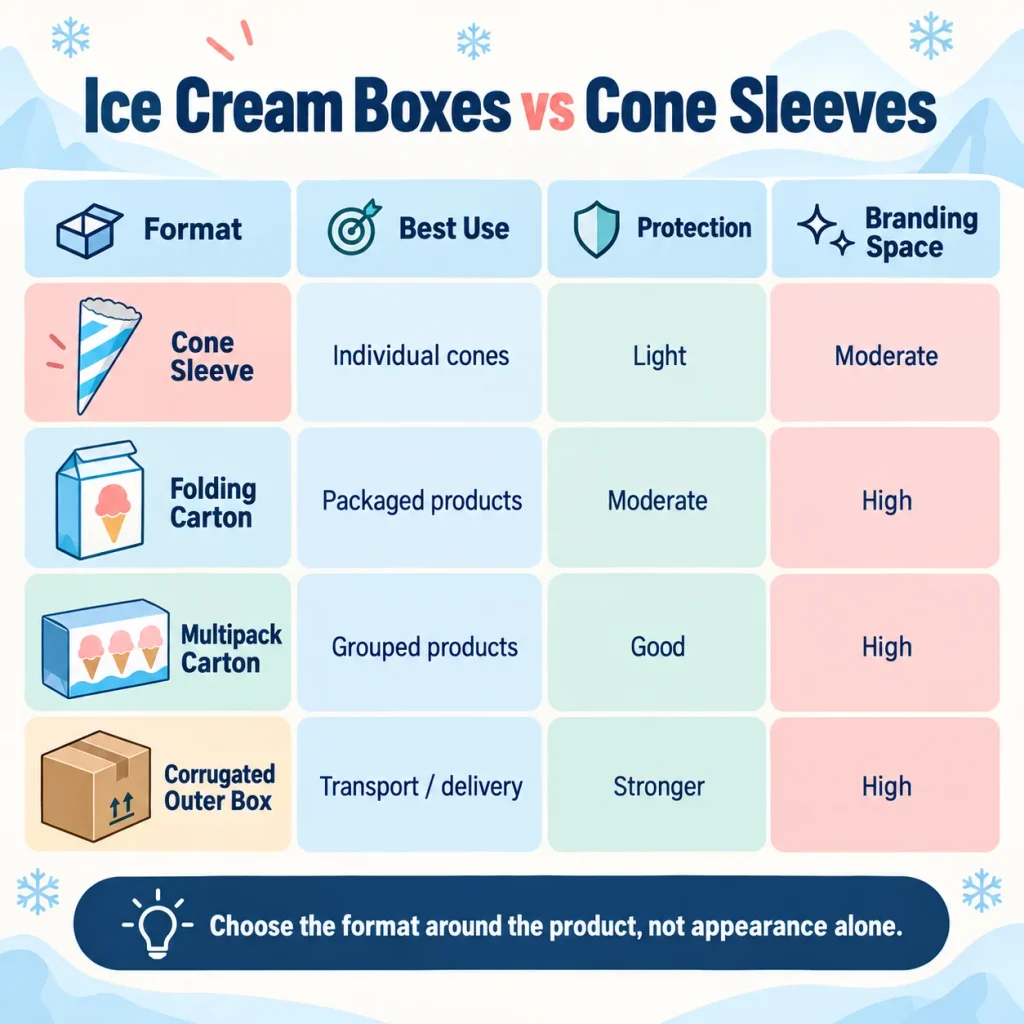
Ice Cream Boxes vs Cone Sleeves: Which Should You Choose?
| Format | Best Use | Protection | Branding Space |
|---|---|---|---|
| Cone Sleeve | Individual cones | Light | Moderate |
| Folding Carton | Packaged products | Moderate | High |
| Multipack Carton | Grouped products | Good | High |
| Corrugated Outer Box | Transport/delivery | Stronger | High |
Cone sleeves work best when partial coverage is enough. Folding cartons are more suitable where the brand needs greater print area or the product needs more structure.
The decision should follow the product rather than whichever format looks most impressive in isolation.
Ice Cream Packaging Ideas for Small Businesses
Independent parlours, dessert shops and smaller food brands usually benefit from simple packaging systems.
One box structure can often work across several flavours. Individual varieties can then be distinguished using artwork, labels or colour changes.
Useful ice cream packaging ideas for small businesses include:
- branded cone sleeves;
- compact printed cartons;
- simple kraft designs;
- flavour-specific colour systems;
- multipack boxes; and
- selected premium finishes for special ranges.
Assembly is also worth considering. Packaging that requires several folds, inserts and decorative pieces may become inconvenient during busy service periods.

How to Design Ice Cream Packaging That Stands Out
Make the Brand Easy to Recognise
Keep logo placement and core visual elements consistent across the range.
Use Colour to Separate Flavours
Colour can help customers distinguish products quickly without changing the complete design system.
Keep Product Names Easy to Read
Flavour names and key information should remain clear at normal viewing distance.
Use Illustrations With Purpose
Illustrations can add personality, particularly for playful or artisan brands, but they should not overwhelm essential information.
Choose Finishes Selectively
Foil, embossing and coatings should support the brand rather than compete for attention.
Brands that need help turning artwork into a workable printed structure can also use Hi Custom Boxes’ packaging design support for layout, structural and print-ready design assistance.
How Printing Changes Ice Cream Packaging
Printing can make the same box structure feel very different.
CMYK suits colourful illustrations, gradients and artwork containing several shades. Pantone printing can be useful where a specific brand colour needs closer control.
The board also influences the printed result. White board and natural kraft, for example, do not produce colour in exactly the same way.
For important branding, colour expectations should be reviewed before production rather than judged only from a screen.
Ice Cream Packaging for Retail, Takeaway and Delivery
Retail Packaging
Retail packaging should prioritise product recognition, clear presentation and a tidy fit.
Takeaway Packaging
Takeaway formats should remain easy to handle and should not slow service with unnecessary components.
Delivery Packaging
Delivery introduces additional handling.
A branded retail carton may need a stronger outer corrugated box to manage transport. Products should be arranged so that movement is controlled without relying on excessive filling material.
Again, packaging provides physical protection; frozen products still require suitable temperature management throughout delivery.
How to Reduce Unnecessary Ice Cream Packaging
More packaging does not automatically mean better packaging.
Review whether the product genuinely needs:
- oversized cartons;
- multiple inner layers;
- decorative sleeves over already printed boxes;
- unnecessary dividers;
- mixed-material components; or
- finishes that add little practical or visual value.
Right-sized paper and cardboard packaging can reduce unnecessary material while keeping the final presentation professional.
Common Ice Cream Packaging Mistakes
Choosing the box before measuring the product: Work from finished dimensions.
Using an oversized carton: Excess space can allow movement and make the pack feel poorly considered.
Selecting board for appearance only: Strength and handling matter too.
Ignoring moisture or condensation: Paper-based packaging should be specified for the intended conditions.
Making flavours hard to identify: Product variations should be clear without losing brand consistency.
Overusing finishes: More effects do not automatically improve the design.
Adding too many components: Every sleeve, divider or insert should solve a real problem.
Using retail packaging as full delivery protection: Outer transport packaging may still be necessary.
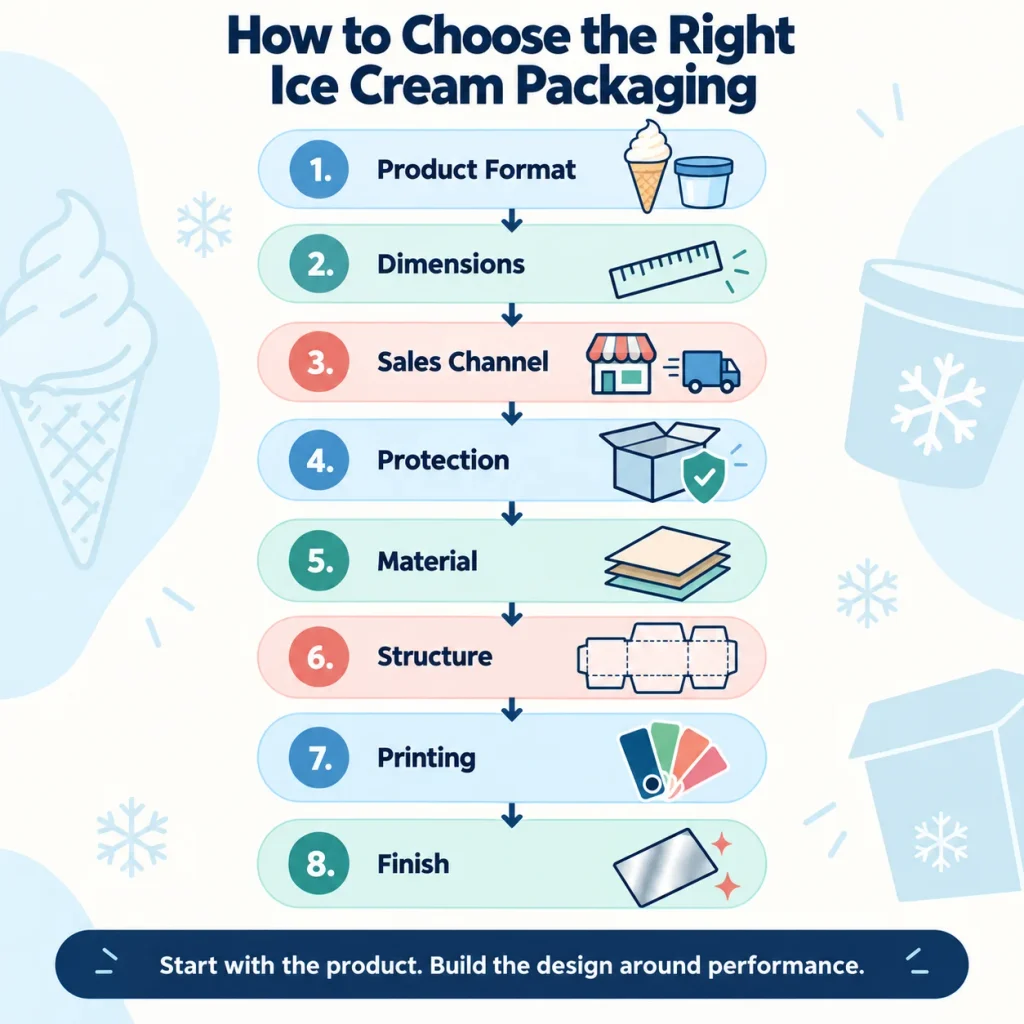
How to Choose the Right Ice Cream Packaging
A practical sequence is:
Product format → Dimensions → Sales channel → Protection → Material → Structure → Printing → Finish
Start with the physical product and how it will be handled.
Once the structure and board are right, use printing and finishing to create the visual identity. This keeps the packaging practical rather than designing everything around appearance first.
Custom Ice Cream Packaging for UK Brands
Hi Custom Boxes supports UK food businesses with paper and cardboard packaging designed around product dimensions, branding and presentation requirements.
Options include printed folding cartons, kraft boxes, corrugated outer packaging, multipack structures, dividers and cone sleeves. The wider custom food packaging range also covers different box styles for retail, takeaway and delivery applications.
For a better fit, provide the finished product dimensions, preferred packaging format, artwork requirements and details of how the packaging will be used.
Custom packaging works best when the structure is built around the product rather than forcing the product into an unsuitable generic carton.
Final Thoughts
The strongest ice cream packaging ideas solve a practical need first.
A cone sleeve may be enough for an individual serving. A folding carton may work for a packaged product. Multipacks need organised internal space, while delivery can require stronger corrugated outer protection.
Choose the structure around the product, then use colour, printing and design to build recognition.
That balance between practical performance and visual identity is what makes ice cream packaging work.
Need packaging advice for your next order?
Share your box size, material, quantity, and artwork needs. Our team can guide you before production starts.